BonusMEBH-03-11
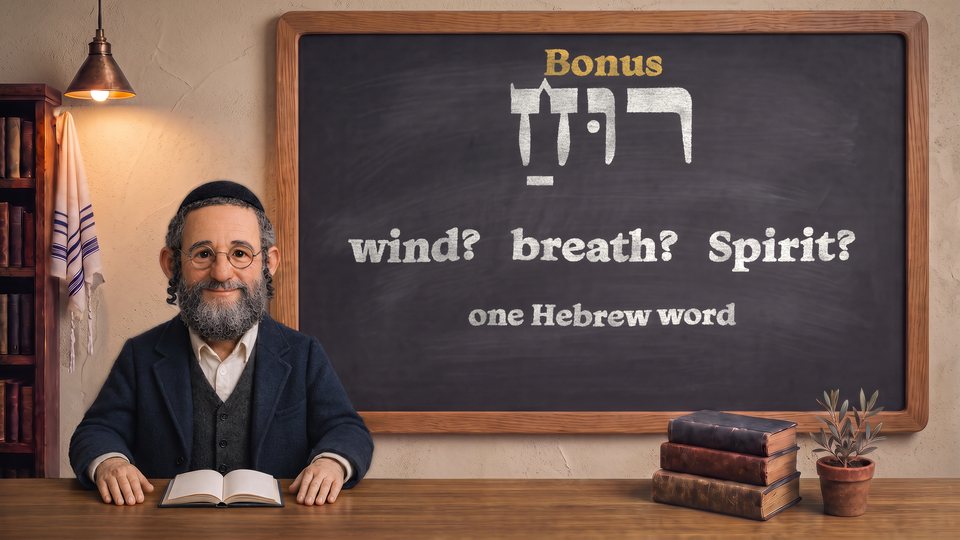
Wind, breath, spirit
Read the end of Genesis 1:2 in Hebrew yourself, and see why one word is wind in one verse, breath in the next and spirit in a third
TranscriptEvery word of the film, with the Hebrew
Download PDFTap a time to play the film from there.
The hook
The second verse of the Bible. וְרוּחַ אֱלֹהִים מְרַחֶפֶת עַל פְּנֵי הַמָּיִם Ve-ruach Elohim merachefet al penei ha-mayim. The King James writes: and the Spirit of God, moved upon the face of the waters. Other Bibles write: a wind from God. Both are translating the same Hebrew word.
רוּחַ Ruach. It stands three hundred and seventy-eight times in the Bible. And no English word covers what it covers. Today: one word; and everywhere it goes.
Welcome
שָׁלוֹם Shalom. I am Moreh Ezra; and this is a bonus. Shorter than a lesson; free; and with no new rules. You learned this word in Lesson six, with three meanings on one line: spirit, wind, breath. In Lesson thirteen, I said: the spirit of God; and moved on quickly.
I owe you the long answer. You have the participle now; and the stems. Today, they go to work on one word.
Genesis 1:2, word by word
Take the line apart. You can do every piece yourself. וְרוּחַ Ve-ruach. And; from Lesson five. Then the word.
Hear its last sound: רוּחַ ruach. The little a slips in before the throat letter; Lesson four. רוּחַ אֱלֹהִים Ruach Elohim. Two nouns; the first leaning on the second. The רוּחַ ruach, of God.
Lesson six.
Now the verb. מְרַחֶפֶת Merachefet. A participle: something going on. It begins with an m; and its middle letter is one that refuses the dot. A פִּעֵל Piel; you heard that last time.
And look at its ending. A t. That is the ending of a she. So our word is a she. In Hebrew, the רוּחַ ruach is feminine.
עַל פְּנֵי הַמָּיִם Al penei ha-mayim: over the face of the waters.
So far, the grammar. It tells you this. A רוּחַ ruach that belongs to God, or comes from God; was doing something over the water; and went on doing it. It does not tell you whether to write wind; breath; or Spirit.
The verb helps; a little. Its root stands three times in the whole Bible. In this stem, only twice. The other time; it is a bird. כְּנֶשֶׁר יָעִיר קִנּוֹ עַל גּוֹזָלָיו יְרַחֵף Ke-nesher ya’ir qinno al gozalav yerachef.
Like an eagle that stirs up its nest; that hovers over its young. Whatever the רוּחַ ruach of the second verse is; it moves over the waters, the way a great bird moves over its nest.
Wind
The plainest meaning first. Air; that moves. The second רוּחַ ruach in the Bible, you met last time. The garden: לְרוּחַ הַיּוֹם le-ruach ha-yom. At the רוּחַ ruach of the day.
The King James: in the cool of the day. It is the breeze.
After the flood. וַיַּעֲבֵר אֱלֹהִים רוּחַ עַל הָאָרֶץ Va-ya’aver Elohim ruach al ha-arets. And God made a רוּחַ ruach pass over the earth; and the waters went down. Hardly any Bible writes, Spirit, there. But listen.
A רוּחַ ruach; from God; over the waters. Whoever wrote that, had the second verse of the Bible in his ear.
At the sea. The story says: בְּרוּחַ קָדִים עַזָּה be-ruach qadim azzah. With a strong east רוּחַ ruach; all night. One chapter later, the song tells the same night. וּבְרוּחַ אַפֶּיךָ נֶעֶרְמוּ מַיִם U-ve-ruach appekha ne’ermu mayim.
And by the רוּחַ ruach of your nostrils; the waters piled up. The east wind of the story; is the breath of God’s nose, in the poem. In Hebrew, that is not a change of word.
Winds come from four directions. So the word can simply mean: a side. And the wind is what you cannot catch. The Preacher looks at everything done under the sun; and calls it: וּרְעוּת רוּחַ u-re’ut ruach. The King James: vexation of spirit.
Bibles today: chasing after wind.
Breath
Wind, inside a living body; is breath. When the flood is announced, it is to destroy כָּל בָּשָׂר אֲשֶׁר בּוֹ רוּחַ חַיִּים kol basar asher bo ruach chayyim. All flesh, in which is the רוּחַ ruach of life. That was the verse of Lesson thirteen. The animals walk into the ark, with the same words.
This is not something only people have. Whatever breathes; has רוּחַ ruach.
One psalm has the word twice, in two lines. תֹּסֵף רוּחָם יִגְוָעוּן Tosef rucham yigva’un. You take away their רוּחַ ruach; they die. תְּשַׁלַּח רוּחֲךָ יִבָּרֵאוּן Teshallach ruchakha yibbare’un. You send out your רוּחַ ruach; they are created.
The King James: their breath; and then: thy spirit. The Hebrew word has not moved. And look at the two verbs; you can name them now. תְּשַׁלַּח Teshallach: the פִּעֵל Piel, send out; from last time. יִבָּרֵאוּן Yibbare’un: a נִפְעַל Niphal; they are created.
And Ezekiel, in the valley of the dry bones. In fourteen verses, the word stands ten times; and the King James needs three English words for it. One sentence has them all. מֵאַרְבַּע רוּחוֹת בֹּאִי הָרוּחַ Me-arba ruchot bo’i ha-ruach. Come from the four winds; O breath.
In Hebrew: One word; twice. And the command, בֹּאִי bo’i, ends in the sound that speaks to a woman; Lesson eleven. The prophet calls the רוּחַ ruach; as you would call a she.
When the breath goes, you are finished. When it comes back; so do you. And when the Queen of Sheba has seen Solomon’s house, his table, and his servants; the story says: וְלֹא הָיָה בָהּ עוֹד רוּחַ ve-lo hayah vah od ruach. There was no more רוּחַ ruach in her. We would say: it took her breath away.
Temper, mind, spirit
How you breathe; shows how you are. So the word is also what goes on inside a person. When Moses brings good news to the slaves in Egypt; they do not listen: מִקֹּצֶר רוּחַ mi-qotser ruach. From shortness of רוּחַ ruach. The King James: for anguish of spirit.
But hear the Hebrew. These are people working so hard, that they are out of breath.
Short and long then become two characters. וּקְצַר רוּחַ U-qtsar ruach: short of רוּחַ ruach. The quick-tempered man. אֶרֶךְ רוּחַ Erekh ruach: long of רוּחַ ruach. The patient one.
English says: short-tempered; and long-suffering; and never notices that it is counting breaths.
And then; the רוּחַ ruach that is God’s. רוּחַ אֱלֹהִים Ruach Elohim. These two words stand together sixteen times in the Bible. The first is our verse. The second is spoken by an Egyptian king; about a Hebrew slave, who has just explained his dreams.
אִישׁ אֲשֶׁר רוּחַ אֱלֹהִים בּוֹ Ish asher ruach Elohim bo. A man, in whom is the רוּחַ ruach of God.
Here the language stops; and the reader’s own understanding begins. But one thing, the language can still tell you. Hebrew has no capital letters. Every Spirit with a capital S in your Bible; and every spirit with a small one; is a decision that a translator made for you. In the second verse of the Bible; you have now seen what he had to decide.
One word
Everything, on one board. One word. רוּחַ Ruach. Air, that moves. Outside: wind.
In a living body: breath. Inside a person: temper; mind; spirit. And the רוּחַ ruach of God. Hebrew has one word for all of it; and it does not choose for you.
And one small surprise. The English word, spirit; is itself a word for breath. It is Latin. You can still hear the breathing in: respiration; and: expire. English forgot.
Hebrew never did.
Before next time
One thing to do before the next lesson; and this one needs Biblion. Biblionapp.com. Open Ezekiel thirty-seven; and in Options, switch to the Study Bible. Read verses one to fourteen in the King James line; and tap the small number after every spirit, breath, and wind. Ten times, it will show you the same word.
For each one, decide for yourself. Wind? Breath? Or spirit? In verse nine, you will decide four times in one sentence.
Next time: the last two stems; and the riddle I left you, on the first day. Keep this word close. You will meet it three hundred and seventy-eight times.
Until next time: לֵךְ לְשָׁלוֹם lekh leshalom. Go in peace.
וְרוּחַ אֱלֹהִים מְרַחֶפֶת עַל־פְּנֵי הַמָּיִם
wərûaḥ 'ĕlōhîm məraḥéfet 'al-pənê hammāyim: "And the Spirit of God moved upon the face of the waters" (Gen 1:2, King James Version)
Other Bibles have "a wind from God swept over the waters". They are translating the same four Hebrew words.
In Lesson 6 you learned רוּחַ rûaḥ with three meanings in one line of the word list: "spirit, wind, breath". In Lesson 13 it stood in the verse at the top, and we wrote "the spirit of God" and moved on quickly. This is the long answer.
This is a bonus: shorter than a lesson, free, and with no new rules. You have the participle now, and the stems. Today they go to work on one word.
rûaḥ stands 378 times in the Hebrew Bible. The King James Version writes "spirit" for it 232 times, "wind" 92 times and "breath" 27 times. Then it needs "side" six times, "mind" five, "blast" four; and once each "cool", "courage", "anger" and "air". No English word covers what this one covers.
1. Genesis 1:2, word by word
וְרוּחַ אֱלֹהִים מְרַחֶפֶת עַל־פְּנֵי הַמָּיִם
wərûaḥ 'ĕlōhîm məraḥéfet 'al-pənê hammāyim
"and the rûaḥ of God was hovering over the face of the waters"
You can take every piece apart yourself:
- וְ wə- "and" (Lesson 5).
-
רוּחַ rûaḥ: the last sound is the slipped-in a before a throat letter (Lesson 4): not rûḥa but rû-aḥ.
-
רוּחַ אֱלֹהִים rûaḥ 'ĕlōhîm: two nouns, the first leaning on the second: "the rûaḥ of God" (Lesson 6).
-
מְרַחֶפֶת məraḥéfet: a participle, so something going on (Lesson 13). It ends in -et, so its subject is a "she": rûaḥ is feminine. It begins with mə-, so it is a Piel (Lesson 15); the middle letter ḥ cannot take the dot.
-
עַל־פְּנֵי 'al-pənê "over the face of": pānîm "face" from the seventy words, leaning on the next word.
-
הַמָּיִם hammāyim "the waters": máyim, with its vowel stretched at the pause, as néfeš was in the last bonus.
So far the grammar. It tells you that a rûaḥ belonging to God, or coming from God, was doing something over the water, and went on doing it. It does not tell you whether to write "wind", "breath" or "Spirit".
The verb helps a little. It is a rare one: its root stands only three times in the Bible, and only twice in this stem. The other time, it is a bird:
כְּנֶשֶׁר יָעִיר קִנּוֹ עַל־גּוֹזָלָיו יְרַחֵף
kənéšer yā'îr qinnô, 'al-gôzālāyw yəraḥēf
"Like an eagle that stirs up its nest, that hovers over its young ..." (Deut 32:11)
Whatever the rûaḥ of Genesis 1:2 is, it moves over the waters the way a great bird moves over its nest. The King James Version says "fluttereth" there, and "moved" in Genesis; most Bibles today say "hovering" in both. (The third time, in the plain stem, it is Jeremiah's bones that "shake", Jer 23:9.)
2. Wind
The plainest meaning first: air that moves.
The second rûaḥ in the Bible stands in a verse you read in Lesson 15. The man and the woman hear God walking about in the garden לְרוּחַ הַיּוֹם lərûaḥ hayyôm, "at the rûaḥ of the day" (Gen 3:8). The King James Version says "in the cool of the day". It is the evening breeze.
After the flood: וַיַּעֲבֵר אֱלֹהִים רוּחַ עַל־הָאָרֶץ wayya'ăvēr 'ĕlōhîm rûaḥ 'al-hā'āreṣ "and God made a rûaḥ pass over the earth", and the waters went down (Gen 8:1). Hardly any Bible writes "Spirit" there. But listen: a rûaḥ, from God, over the waters. Whoever wrote Genesis 8 had Genesis 1 in his ear.
At the sea, the story says: בְּרוּחַ קָדִים עַזָּה bərûaḥ qādîm 'azzâ "with a strong east rûaḥ", all night (Exod 14:21). Look at 'azzâ "strong", with the -â of a she. One chapter later the song tells the same night like this: וּבְרוּחַ אַפֶּיךָ נֶעֶרְמוּ מַיִם ûvərûaḥ 'appêkhā ne'ermû máyim "and by the rûaḥ of your nostrils the waters piled up" (Exod 15:8).
The east wind of the story is the breath of God's nose in the poem. In Hebrew that is not a change of word.
Since winds come from four directions, rûaḥ is also simply a side. When Ezekiel measures the temple he measures its east rûaḥ, its north rûaḥ, its south and its west (Ezek 42:16-20), and the King James Version writes "side".
And the wind is what you cannot catch. The Preacher looks at everything done under the sun and calls it רְעוּת רוּחַ rə'ût rûaḥ (Eccl 1:14), seven times in his book. The King James Version says "vexation of spirit". Bibles today say "chasing after wind".
3. Breath
Wind inside a living body is breath.
When the flood is announced, it is to destroy כָּל־בָּשָׂר אֲשֶׁר־בּוֹ רוּחַ חַיִּים kol-bāśār 'ăšer-bô rûaḥ ḥayyîm "all flesh in which is the rûaḥ of life" (Gen 6:17, the verse of Lesson 13). The animals that walk into the ark are described with the same words (Gen 7:15). As with néfeš, this is not something only people have. Whatever breathes has rûaḥ.
What does not breathe has none. Of an idol plated with gold and silver the prophet says: וְכָל־רוּחַ אֵין בְּקִרְבּוֹ wəkhol-rûaḥ 'ên bəqirbô "and there is no rûaḥ at all inside it" (Hab 2:19).
One psalm has the word twice in two lines, and most English Bibles change it between them:
תֹּסֵף רוּחָם יִגְוָעוּן … תְּשַׁלַּח רוּחֲךָ יִבָּרֵאוּן
tōsēf rûḥām yigwā'ûn ... təšallaḥ rûḥăkhā yibbārē'ûn
"You take away their rûaḥ, they die ... You send out your rûaḥ, they are created." (Ps 104:29-30)
The King James Version: "their breath", and then "thy spirit". The Hebrew word has not moved. (And look at the two verbs you can now name: təšallaḥ is the Piel "send out" of Lesson 15, and yibbārē'ûn is a Niphal of bārā', with the doubled b of Lesson 14: "they are created".)
The great showpiece is Ezekiel's valley of dry bones. In fourteen verses (Ezek 37:1-14) rûaḥ stands ten times, and the King James Version needs three English words for it: "spirit", "breath" and "wind". One verse has all the confusion at once:
מֵאַרְבַּע רוּחוֹת בֹּאִי הָרוּחַ
mē'arba' rûḥôt bō'î hārûaḥ
"Come from the four winds, O breath." (Ezek 37:9)
Word for word: "From the four rûaḥs come, O rûaḥ." And the command is בֹּאִי bō'î, with the -î that speaks to a woman (Lesson 11): the prophet calls the rûaḥ as you would call a "she".
When the breath goes, you are finished; when it comes back, so do you. Samson, dying
of thirst, drinks, וַתָּשָׁב רוּחוֹ wattāšov rûḥô "and his rûaḥ came back" (Judg 15:19).
A starving man is given figs and raisins, and the same two words follow (1 Sam
30:12). And when the Queen of Sheba has seen Solomon's house, his table and his
servants, the story says וְלֹא־הָיָה בָהּ עוֹד רוּחַ wəlō'-hāyâ vāh 'ôd rûaḥ "there was no
more rûaḥ in her" (1 Kgs 10:5). The King James Version writes "no more spirit". We
would say: it took her breath away. 
4. Temper, mind, spirit
How you breathe shows how you are. So rûaḥ is also what goes on inside a person.
When Moses brings good news to the slaves in Egypt, they do not listen מִקֹּצֶר רוּחַ miqqōṣer rûaḥ, "from shortness of rûaḥ" (Exod 6:9). The King James Version has "anguish of spirit". But hear the Hebrew: they are people working so hard that they are out of breath.
Short and long rûaḥ then become two characters. קְצַר־רוּחַ qəṣar-rûaḥ, "short of
rûaḥ", is the quick-tempered man (Prov 14:29). אֶרֶךְ־רוּחַ 'érekh-rûaḥ, "long of
rûaḥ", is the patient one (Eccl 7:8). English says "short-tempered" and
"long-suffering", and never notices that it is counting breaths. 
In Genesis, Pharaoh wakes from his dreams וַתִּפָּעֶם רוּחוֹ wattippā'em rûḥô "and his rûaḥ was troubled" (Gen 41:8): a Niphal, with a "she" for its subject. And when old Jacob sees the wagons that Joseph has sent, וַתְּחִי רוּחַ יַעֲקֹב wattəḥî rûaḥ ya'ăqōv "the rûaḥ of Jacob came alive" (Gen 45:27).
And then the rûaḥ that is God's. The words rûaḥ 'ĕlōhîm stand sixteen times in the Bible. The first is our verse. The second is spoken by an Egyptian king, about a Hebrew slave who has just explained his dreams:
הֲנִמְצָא כָזֶה אִישׁ אֲשֶׁר רוּחַ אֱלֹהִים בּוֹ
hănimṣā' khāzê 'îš 'ăšer rûaḥ 'ĕlōhîm bô
"Can we find a man like this, in whom is the rûaḥ of God?" (Gen 41:38)
Isaiah sets the word against its opposite: the horses of Egypt are בָּשָׂר וְלֹא־רוּחַ bāśār wəlō'-rûaḥ "flesh, and not rûaḥ" (Isa 31:3). You know bāśār from the wedding verse.
What you just did
Look at what you just did. You took the end of Genesis 1:2 apart, word by word, and found a feminine noun, a chain, and a Piel participle that the Bible uses again only for an eagle. Then you followed one word from the wind, to the breath in every living thing, to the temper of a tired slave and a patient man; and to the rûaḥ of God.
You now know three Hebrew words that English mixes up, and they are not the same:
| Word | Times | At home it means | Script |
|---|---|---|---|
| néfeš | 754 | the throat, the appetite, the living creature, "me" | נֶפֶשׁ |
| rûaḥ | 378 | air that moves: wind, breath, temper, spirit | רוּחַ |
| nəšāmâ | 24 | a puff of breath | נְשָׁמָה |
In Genesis 2:7 God breathes into the man the nəšāmâ of life, and the man becomes a living néfeš. Job has the other pair: רוּחַ־אֵל עָשָׂתְנִי וְנִשְׁמַת שַׁדַּי תְּחַיֵּנִי rûaḥ-'ēl 'āśātnî wənišmat šadday təḥayyēnî "The rûaḥ of God has made me, and the nəšāmâ of the Almighty gives me life" (Job 33:4).
Before next time This one needs Biblion: biblionapp.com. Go to Ezekiel 37, and in Options switch to the Study Bible. Read verses 1 to 14 in the King James line, and tap the small number after every "spirit", "breath" and "wind". Ten times Biblion will show you the same word, רוּחַ. For each one, decide for yourself: wind, breath, or spirit? In verse 9 you will have to decide four times in one sentence.
Next time, the last two stems. Keep this word close as well. You will meet it 378 times.