BonusMEBH-02-03
What the translation loses
Use what Lessons 1 to 5 taught you to see four things in Genesis that English has to lose, guess or get lucky with
TranscriptEvery word of the film, with the Hebrew
Download PDFTap a time to play the film from there.
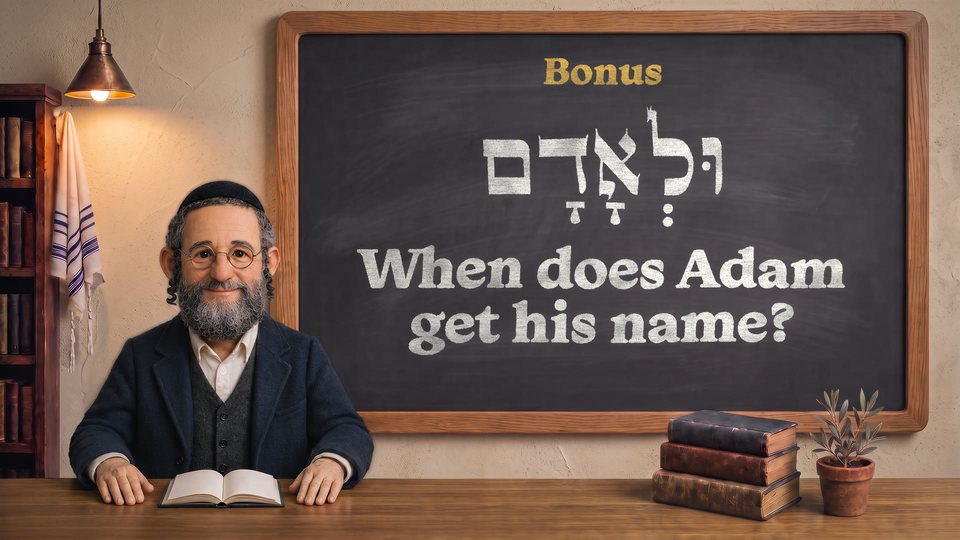
When does Adam get his name?
When does Adam get his name? You would think the Bible says. It does, and it doesn’t. In three verses the whole question hangs on one small mark under one letter. Translators have argued about it for centuries.
After Lesson five, you can see that mark yourself. Let me show you.
This is a bonus
שָׁלוֹם Shalom, and welcome to something a little different. I am Moreh Ezra. This is a bonus. No new letters, no new rules, nothing to memorise. You have worked hard for five lessons, and today you get paid.
I have four small things from the book of Genesis. Every one of them is lost, or guessed, or saved only by luck when the Bible goes into English. And every one of them you can now see with your own eyes, with what you already know. Put the pencil down. Today you may keep it behind your ear.
Chaos that rhymes: tohu va-vohu
The second verse of the Bible. You read it in Lesson five. וְהָאָרֶץ הָיְתָה תֹהוּ וָבֹהוּ Ve-ha-arets hayetah tohu va-vohu. And the earth was formless and empty. Say the last two words aloud with me.
תֹהוּ וָבֹהוּ Tohu va-vohu. Again. תֹהוּ וָבֹהוּ Tohu va-vohu. It rhymes. The earth before anything was made sounds like a children’s rhyme.
In the middle stands our little word and, in the form vah that it takes before a stressed syllable. You know it. Now the two words: תֹּהוּ tohu is emptiness, a waste, a place with nothing to hold on to. It turns up about twenty times in the Bible. בֹּהוּ Bohu is stranger.
It turns up three times in the whole Bible, and never alone. Every time, תֹּהוּ tohu is standing right beside it. So בֹּהוּ bohu is a word that does not go out without its friend. English cannot rhyme here. The King James Bible says without form, and void.
Modern versions say formless and empty. Accurate. Not a rhyme in sight. Other languages simply gave up translating and borrowed the sound. In German, a room in complete disorder is a Tohu-va-bohu.
A teenager’s bedroom is a Tohu-va-bohu. In French, a great racket and confusion is a tohu-bohu. So when a German mother looks into her son’s room, she is quoting Genesis one, verse two. She may not know it. Now you do.
One more place. The prophet Jeremiah sees a vision of his land destroyed, and he says: רָאִיתִי אֶת־הָאָרֶץ וְהִנֵּה־תֹהוּ וָבֹהוּ וְאֶל־הַשָּׁמַיִם וְאֵין אוֹרָם ra’iti et-ha-arets, ve-hinneh tohu va-vohu, ve-el ha-shamayim, ve-ein oram. I looked at the earth, and there it was, formless and empty; and at the heavens, and their light was gone. Earth. Heavens.
תֹהוּ וָבֹהוּ Tohu va-vohu. And אוֹר or, light, the very first thing God made, in Lesson three. Many readers hear creation running backwards in this verse. That is a reading, not something the grammar can prove. But an English reader cannot even hear the question.
You can.
When does "the man" become Adam?
Lesson four gave you the word אָדָם adam. Man, mankind, and the name Adam. One word, three jobs. Which job is it doing? Lesson five holds the key: the article, hah, the.
A name does not take the. In English nobody says the David. In Hebrew nobody does either. So when Genesis says הָאָדָם ha-adam, with hah, it means the man, the human. Not a name.
And that is what Genesis says. From chapter two, verse seven, to chapter four, verse one, the Hebrew says הָאָדָם ha-adam, the man, twenty-one times. Even in chapter four, when he becomes a father, it is still וְהָאָדָם ve-ha-adam, and the man. By chapter five there is no article any more. וַיְחִי אָדָם Vayechi adam: and Adam lived, a hundred and thirty years.
Now it is a name. So where in between does the man get his name? Here is the twist. Three verses have the little preposition leh, to or for, and no article. Chapter two, verse twenty: וּלְאָדָם לֹא־מָצָא עֵזֶר u-le-adam lo matsa ezer, but for Adam he found no helper.
Chapter three, verse seventeen: וּלְאָדָם אָמַר u-le-adam amar, and to Adam he said. And chapter three, verse twenty-one: לְאָדָם le-adam, for Adam. Now remember Lesson five. Leh plus hah makes lah. The h disappears, and only the vowel is left to say the.
So to Adam is לְאָדָם le-adam, and to the man is לָאָדָם la-adam. Look at the board. The letters are the same. Lamed, alef, dalet, mem. Exactly the same.
The only difference is the little mark under the lamed. Two dots, or a small T. And who wrote the little marks? You know this from Lesson one. The Masoretes, many centuries after the letters were written.
In these three verses the letters could be either. The vowels say Adam. So translations disagree about Adam’s birthday as a name. The King James Bible calls him Adam already from chapter two, verse nineteen, where the Hebrew still says the man. Many modern versions keep the man until chapter four, some with a little footnote: or Adam.
Scholars argue. Many think the letters first meant to the man, and the vowels record a later reading that already heard a name. Others defend the vowels as they stand. Nobody can settle it from the letters alone. And you, five lessons into Hebrew, can now see exactly where the argument lives.
One vowel wide. One last thing. The word never quite gives up its first job. In chapter five, verse two, God makes them male and female, and calls their name אָדָם adam. Both of them.
There, אָדָם adam is humankind.
Ish and ishah: a pun English got lucky with
The man sees the woman for the first time, and he makes a pun. Chapter two, verse twenty-three: לְזֹאת יִקָּרֵא אִשָּׁה כִּי מֵאִישׁ לֻקֳחָה־זֹּאת le-zot yiqqare ishah, ki me-ish luqochah-zot. This one shall be called woman, for from man this one was taken. Peel it: אִישׁ ish, man, and אִשָּׁה ishah, woman; both are in your seventy words. מֵאִישׁ Me-ish, from man: that is מִן min, from, glued on.
The alef cannot be doubled, so the vowel stretches instead: meh. Lesson five, section five. And אִשָּׁה ishah sounds like אִישׁ ish with the feminine ending ah from Lesson four. And this time English keeps the pun. Man, woman.
That is luck, and old luck. Our word woman comes from the Old English wifmann: a female person. Mann just meant a person. Now the honest part, because you deserve it. Most dictionaries think אִישׁ ish and אִשָּׁה ishah come from two different roots.
Look at the doubled shin in אִשָּׁה ishah: that dot inside, the dagesh, probably hides a lost n. The plural of אִשָּׁה ishah is נָשִׁים nashim, women, and there the n is back. Some scholars connect the two words anyway; it is debated. Either way, the verse is not a dictionary. It plays with sound, as Hebrew writers love to do.
And the sound really is close. Close enough for a man to make his first joke.
Babel: a pun, not a dictionary
Last one. The tower. Chapter eleven, verse nine: עַל־כֵּן קָרָא שְׁמָהּ בָּבֶל כִּי־שָׁם בָּלַל al-ken qara shemah Bavel, ki sham balal, the LORD, שְׂפַת כָּל־הָאָרֶץ sefat kol ha-arets. That is why its name was called Babel: for there the LORD confused the language of all the earth. Look at the verb: בָּלַל balal.
Root B, L, L, in the pattern from Lesson four: he did it. It means he mixed, he confused. Now say it next to the name: בָּבֶל Bavel, בָּלַל balal. B, B, L. B, L, L.
A Hebrew ear smiles. But the Babylonians had their own explanation of their city’s name: bab-eelee, gate of god, in their language, Akkadian. Many historians think even that was a reinterpretation of an older name. So a city that called itself Gate of God hears its name from Genesis as Mix-up. It is a wordplay, not a history of the word, and the narrator knows it perfectly well.
And our English word babble? It looks like Babel, but the dictionaries say it comes from the sound of baby talk, ba-ba-ba. A happy coincidence. I checked, so you don’t have to. The verse goes on: וּמִשָּׁם u-mi-sham, and from there he scattered them.
Peel it: oo, and; mee, from, which doubles the next letter; and שָׁם sham, there. Three words in one, and you read every piece.
What you just did
Look at what you did today. You heard a rhyme no English Bible keeps. You found the exact vowel that decides when Adam gets his name. You caught a pun, and a dagesh hiding a lost letter. And you got a joke about Babylon that is three thousand years old.
Five lessons. That is all it took. Imagine what twenty will do.
Try it yourself in Biblion
One thing to do before next time. Open Biblion, at Biblion app dot com, and go to Genesis three, verse seventeen. In Options, switch to the Interlinear. The first word is וּלְאָדָם u-le-adam. Look under it at the meaning Biblion gives, and then look at your own translation of the verse.
Did your Bible say Adam, or the man? Now go back to chapter two, verse nineteen, and do the same. Now you know which kind of Bible you own. Next time we are back to work: nouns, masculine and feminine, and how Hebrew says the X of Y. Bring the pencil back from behind your ear.
Until next time: לֵךְ לְשָׁלוֹם lekh leshalom. Go in peace.
וּלְאָדָם אָמַר
ûlə'ādām 'āmar: "And to Adam he said" (Gen 3:17)
...or was it "And to the man he said"? By the end of this bonus you can see for yourself why translations disagree.
This is a bonus: shorter and lighter than a lesson, and free. There is nothing new to memorise. Every find below uses only what you already know: roots and patterns (Lesson 4) and the little words on the front (Lesson 5). Four short stops, each with a question or two, then a last round where you do the spotting.
1. Chaos that rhymes
You read this in Lesson 5:
וְהָאָרֶץ הָיְתָה תֹהוּ וָבֹהוּ
wəhā'āreṣ hāyətâ tōhû wāvōhû
"And the earth was formless and empty." (Gen 1:2)
Say the last two words aloud: tōhû wāvōhû.  They rhyme. The middle wā- is our friend
"and", in the form it takes before a stressed syllable (Lesson 5).
tōhû means emptiness, a waste, nothing to hold on to; it appears about twenty times.
bōhû appears only three times in the whole Bible, and never on its own: always beside
tōhû. It is a word that only goes out with its partner. 
English has to choose plain words: "without form, and void" (KJV), "formless and empty". The rhyme is gone. Other languages liked the sound so much that they simply took it: in German a chaotic mess, a teenager's bedroom for instance, is a Tohuwabohu, and French says tohu-bohu.
The pair appears once more, in Jeremiah, in a vision of a land destroyed:
רָאִיתִי אֶת־הָאָרֶץ וְהִנֵּה־תֹהוּ וָבֹהוּ וְאֶל־הַשָּׁמַיִם וְאֵין אוֹרָם
rā'îtî 'et-hā'āreṣ wəhinnēh-tōhû wāvōhû wə'el-haššāmáyim wə'ên 'ôrām
"I looked at the earth, and there it was, formless and empty; and at the heavens, and their light was gone." (Jer 4:23)
Earth and heavens, tōhû wāvōhû, and 'ôr, the light of Genesis 1:3. Many readers hear creation running backwards here. That is a reading, not something the grammar proves, but you can now hear the echo yourself, which no English reader can.
2. When does "the man" become Adam?
Lesson 4 gave you אָדָם 'ādām: "man, mankind; Adam". One word, three meanings. Which one? Lesson 5 holds the key: the article.
A personal name does not take "the": in Hebrew, as in English, nobody says "the David". So when Genesis says הָאָדָם hā'ādām, with hā-, it means "the man", "the human", not a name. And that is what Genesis says, again and again: from 2:7 to 4:1, hā'ādām stands twenty-one times.
| Verse | Hebrew | Read it | Meaning |
|---|---|---|---|
| Gen 2:7 | הָאָדָם | hā'ādām | the man (formed from the ground) |
| Gen 4:1 | וְהָאָדָם | wəhā'ādām | and the man (knew Eve) |
| Gen 5:3 | וַיְחִי אָדָם | wayḥî 'ādām | and Adam lived (130 years) |
Gen 5:3 has no article: now it is a name. (Notice wayḥî, the narrative chain form of Lesson 3, like wayhî.)
So where does the name begin? Here is the twist. Three verses in between have the preposition lə- "to, for" and no article vowel:
| Verse | As the vowels have it | Read it | Meaning | With "the" it would be |
|---|---|---|---|---|
| Gen 2:20 | וּלְאָדָם לֹא־מָצָא | ûlə'ādām lō'-māṣā' | but for Adam he did not find (a helper) | וְלָאָדָם wəlā'ādām "but for the man" |
| Gen 3:17 | וּלְאָדָם אָמַר | ûlə'ādām 'āmar | and to Adam he said | וְלָאָדָם wəlā'ādām "and to the man" |
| Gen 3:21 | לְאָדָם וּלְאִשְׁתּוֹ | lə'ādām ûlə'ištô | for Adam and for his wife | לָאָדָם lā'ādām "for the man" |
Remember Lesson 5: lə- + ha- = lā-, and the "h" disappears. So "to Adam" and "to the man" are written with exactly the same letters: ולאדם. Only the little vowel under the lamed is different. And the vowels, as you learned in Lesson 1, were added by the Masoretes many centuries after the letters.
The word never quite stops doing both jobs. In Gen 5:2, God "called their name 'ādām", the man and the woman together: there it means humankind.
3. Man and woman: a pun English got lucky with
לְזֹאת יִקָּרֵא אִשָּׁה כִּי מֵאִישׁ לֻקֳחָה־זֹּאת
ləzō't yiqqārē' 'iššâ kî mē'îš luqŏḥâ-zō't
"This one shall be called woman, for from man this one was taken." (Gen 2:23)
Peel the pieces you know:
- אִישׁ 'îš "man", one of your seventy words, and אִשָּׁה 'iššâ "woman".
-
מֵאִישׁ mē'îš "from man": min "from" glued on. Before alef, which can't be doubled, it becomes mē- (Lesson 5, section 5).
-
'iššâ sounds like 'îš with -â, the feminine ending of Lesson 4.
Now the honest part. Most dictionaries think 'îš and 'iššâ come from two different roots. The doubled š in 'iššâ (a dagesh, Lesson 3) probably hides a lost n: its plural is נָשִׁים nāšîm "women", and there the n is back. Some scholars connect the two words anyway; it is debated. Either way the verse is not giving a dictionary lesson. It plays on sound, as Hebrew writers love to do, and the sound really is close.
4. Babel: a pun, not a dictionary
עַל־כֵּן קָרָא שְׁמָהּ בָּבֶל כִּי־שָׁם בָּלַל יְהוָה שְׂפַת כָּל־הָאָרֶץ
'al-kēn qārā' šəmāh bāvel kî-šām bālal [the LORD] śəfat kol-hā'āreṣ
"That is why its name was called Babel, for there the LORD confused the language of all the earth." (Gen 11:9)
Look at the verb: בָּלַל bālal, root B-L-L, in the pattern CāCaC, "he did it" (Lesson 4). It means he mixed, he confused. Now say it beside the name: bāvel, bālal. B-B-L and B-L-L: close enough to make a Hebrew ear smile.
The Babylonians explained their city's name very differently: bāb-ili, "gate of god" in their own language, Akkadian. (Many historians think even that was a reinterpretation of an older name.) Genesis takes a city that called itself "Gate of God" and hears in its name "Mix-up". That is a wordplay, not a history of the word, and the narrator knows it.
The verse goes on with a word you can peel three ways:
וּמִשָּׁם הֱפִיצָם
ûmiššām hĕfîṣām: "and from there he scattered them"
û- "and" (this form because an m follows, Lesson 5) + mi- "from", which doubles the next letter + שָׁם šām "there". And from there.
See it yourself
No new rules: only what you used above. Type in plain letters, as always.