Wrap-upMEBH-02-05
The whole alphabet
Put all twenty-two letters and every vowel sign in order, meet the throat letters as a family, and tie up the last loose ends of reading
TranscriptEvery word of the film, with the Hebrew
Download PDFTap a time to play the film from there.
Every letter
Six lessons ago, you did not know alef. Today you know every letter in the Hebrew Bible; and there are one million, one hundred and ninety-seven thousand of them. But you met them a few at a time, between kings, and roots, and little words. Today we lay them all on one board, in order. We tie up three loose ends.
And we close the stage.
The easy one
שָׁלוֹם Shalom, and welcome to the first wrap-up. I am Moreh Ezra. A wrap-up stands at the end of a stage. It teaches almost nothing new. It puts what you know in order, so that nothing rattles when you walk on.
So this is the easy one. Five short parts. The alphabet, in its order. The letters that look alike. The letters from the throat.
Every vowel, on one board. And the dot, which has taken on more work since we last counted. Three small things will be new, and I shall say so when they come. And at the end, as always, a verse.
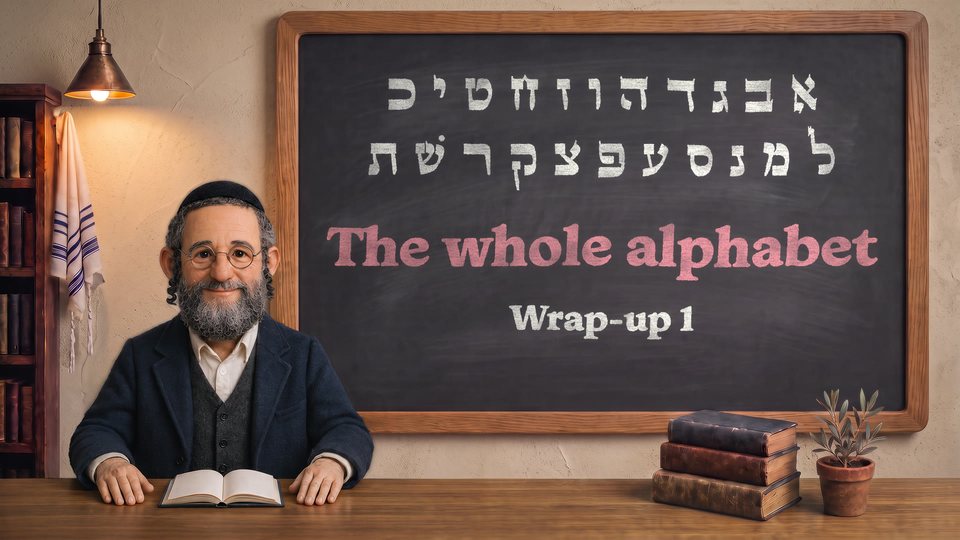
Twenty-two letters in order
Here they are, in their order, from the right. Alef, bet, גִּימֶל gimel, דָּלֶת dalet, הֵא he, vav, זַיִן zayin, חֵית het, Tet, yod, כַּף kaf. Lamed, mem, נוּן nun, סָמֶךְ samekh, עַיִן ayin, פֵּא pe, צָדֵי tsade, קוֹף qof, resh, shin, tav. Twenty-two. That order has hardly moved in three thousand years.
Hardly; I shall come back to that. You need it for two things. The first is the dictionary. Every Hebrew dictionary runs from alef to tav; and without the order, you will read half the book every time you look up a word. The second is poetry.
The poets of the Bible wrote alphabets: poems where each verse begins with the next letter. Psalm one hundred and nineteen is the great one. Eight verses for alef, eight for bet, and so on, down to tav. One hundred and seventy-six verses: the longest chapter in the Bible. The poet could not stop before tav.
In Lesson six, Boaz called Ruth a woman of valour. The book of Proverbs ends with a poem about such a woman: twenty-two verses, from alef to tav. Praise from A to Z. And the book of Lamentations is four alphabets, and then a silence: chapter five has twenty-two verses, and no alphabet at all. Now the hardly.
In chapters two, three and four of Lamentations, פֵּא pe comes before עַיִן ayin. Two letters have changed places. Either the order was not quite settled yet; or somebody’s teacher has a great deal to answer for.
The five end-shapes
Five letters change their shape at the end of a word. כַּף Kaf, mem, נוּן nun, פֵּא pe, צָדֵי tsade. Four of them drop a tail below the line. Mem shuts itself into a box. Say the five in order, and they make one word: כַּמְנֶפֶץ kamnefets.
It means nothing whatever. It is a peg, to hang five letters on. One word for each. מֶלֶךְ Melekh: a king. שָׁלוֹם Shalom: peace.
בֵּן Ben: a son. כֶּסֶף Kesef: silver. אֶרֶץ Erets: the earth. And one verse in the whole Bible holds every letter of the alphabet, and all five end-shapes as well. Zephaniah, chapter three, verse eight.
I went through all twenty-three thousand verses to be sure; so that you do not have to.
Letters that look alike
Most slips in reading come from a handful of letters that look alike. Bet, and כַּף kaf. Bet has a corner, and a small foot sticking out behind. כַּף Kaf is round. דָּלֶת Dalet, and resh.
The corner is D: you know that one. And if you still mix them up, you are in good company. In Genesis, among the great-grandsons of Noah, there is a people called the Dodanim. The book of Chronicles copies the same list; and there, they are the Rodanim. One verse earlier, Riphath has become Diphath.
Somewhere, a long time ago, a scribe had a bad afternoon with these two letters. Next: הֵא he, חֵית het, tav. הֵא He has a gap at the top left. חֵית Het is shut. Tav has a foot.
Then vav, זַיִן zayin, and final נוּן nun. Vav is plain. זַיִן Zayin wears a hat. Final נוּן nun goes on down, below the line. סָמֶךְ Samekh, and final mem.
Round, and square. עַיִן Ayin, and צָדֵי tsade. עַיִן Ayin has a tail that runs away to the left. צָדֵי Tsade sits flat on the line. And גִּימֶל gimel, and נוּן nun.
גִּימֶל Gimel has a foot. נוּן Nun has a flat base. Now four pairs that do not look alike, but sound alike. כַּף Kaf with its dot, and קוֹף qof: both say K. Tav, and Tet: both say T.
סָמֶךְ Samekh, and sin: both say S. And alef, and עַיִן ayin: both say nothing, in perfect agreement. Once, each of them had a sound of its own. The spelling has not forgotten. It is how you find a word in the dictionary; and how you tell one root from another.
Letters from the throat
Four letters are made in the throat. Alef, הֵא he, חֵית het, עַיִן ayin. Resh often keeps them company. More than one letter in five in the Bible is one of these four. They are a family; and like most families, they have habits.
Three of them; and they explain spellings that you have already read. Habit one: they will not be doubled. The little word the doubles the letter after it. הַשָּׁמַיִם Ha-shamayim: the heavens; with a dot in the shin. Before alef, it cannot.
So its own vowel grows long instead. הָאָרֶץ Ha-arets: the earth. In Lesson two I told you that the vowel changes there. Now you know why. Habit two: they will not carry a bare שְׁוָא shewa.
Under an ordinary letter, a word may begin with one. בְּרֵאשִׁית Bereshit. A throat letter wants a little more: so the שְׁוָא shewa is given a vowel to sit beside it. The hurried e: אֱלֹהִים Elohim. The hurried a: אֲשֶׁר asher; who, or which.
The hurried o: אָהֳלוֹ oholo; his tent. I counted the hurried vowels in the Bible. Thirty thousand, seven hundred and five. More than ninety-eight in every hundred stand under one of these four letters. Habit three: they like the sound ah.
Open your mouth, and say ah. That is your throat. Your doctor asks for that vowel for a reason. So when a word ends in חֵית het or עַיִן ayin, a small ah slips in, before the letter. רוּאַח Ruach: spirit.
נוֹאַח Noach: Noah. שֹׁמֵעַ Shomea: one who hears.
Every vowel on one board
Now, every vowel on one board. Hebrew has five vowel sounds; and each can be long, short, or hurried. That is the whole system. The rest is names; and names are for examinations. The first sound: ah.
Long: קָמָץ qamets. Short: פַּתַח patach. Hurried: the hurried a. Eh. The long one: צֵירֵי tsere; with or without a yod behind it.
Short: סֶגּוֹל segol. Hurried: the hurried e; and the שְׁוָא shewa itself. Ee. Long: with a yod. Short: without.
Oh. Long: the dot on top; with its vav, or without. Hurried: the hurried o. Short: wait. Oo.
Long: the vav with the dot in the middle. Short: three dots on a slant. That is the board; with one hole in it. The short o. Here it is.
Look closely. It is a קָמָץ qamets. That is the first new thing today; and it is the one trap in the vowels. The same sign: but in a short, shut syllable, with no stress on it, it says o. Its name is קָמָץ חָטוּף qamets hatuf.
You have been saying it for weeks. Here is the word for all. It looks like kal. It is כָּל kol; more than four thousand times. חָכְמָה Chokhmah: wisdom.
And the first vowel of אָהֳלוֹ oholo, his tent. Why one sign for two sounds? The scribes who invented the signs said the two alike; so, for them, one sign was enough. The trap was laid later, by people who pronounce the way I do. I apologise.
Do not work it out. This course writes the sound under every word; and the common ones, you will simply know.
Now: letters that help a vowel, and say nothing themselves. You know the yod after a חִירִיק hireq, and the vav. Three more. צֵירֵי Tsere, with a yod: בֵּין bein; between. The second new thing: סֶגּוֹל segol, with a yod.
אֱלֹהֶיךָ Elohekha: your God. And קָמָץ qamets, with a silent הֵא he at the end of a word. מַלְכָּה Malkah: a queen. לָיְלָה Laylah: night.
One dot, four jobs
Now the dot. In Lesson three it had two jobs, and no extra pay. It has four now. The pay has not changed. Job one: it makes a letter hard.
בָּרָא Bara: he created. B, not V. Job two: it doubles a letter. הַמַּיִם Ha-mayim: the waters. Lean on the mem.
Job three: inside a vav, it is the vowel oo. רוּחַ Ruach. And job four, the last new thing today: a dot in a הֵא he, at the end of a word. You know that a last הֵא he is silent. With a dot in it, it is a real h again.
לָהּ Lah: to her. A careful reader breathes it out. The rest of us mean to. The dot is called מַפִּיק mappiq; and more than four times in five, it means her, or its. Now two words that you met in Lesson four.
The man is put in the garden לְעָבְדָהּ וּלְשָׁמְרָהּ le-ovdah u-le-shomrah: to work it, and to keep it. That day I said: do not mind the vowels. Today you may mind them. Each word has the short o that looks like a קָמָץ qamets. And each ends in a הֵא he with a dot: it.
And I counted the dots. One hundred and seventy thousand, eight hundred and twenty-six of them. No vowel sign in the whole Bible is written as often as that one dot. It does four jobs, because somebody has to.
Genesis 1:31
Now the verse. It closes the six days of creation. Everything in it has a name now. You read it first; take your time.
וַיַּרְא אֱלֹהִים אֶת כָּל אֲשֶׁר עָשָׂה Va-yar Elohim et kol asher asah, וְהִנֵּה טוֹב מְאֹד ve-hinneh tov me’od. וַיְהִי עֶרֶב Va-yehi erev, וַיְהִי בֹקֶר va-yehi voqer, יוֹם הַשִּׁשִּׁי yom ha-shishi. And God saw all that he had made; and behold, it was very good. And there was evening, and there was morning: the sixth day. Three things to see.
כָּל Kol: the short o that looks like a קָמָץ qamets. אֲשֶׁר Asher: the hurried a, under a throat letter. הַשִּׁשִּׁי Ha-shishi: the, and after it, a doubled shin.
And now, count with me. Six times in this chapter, God saw that it was good. כִּי טוֹב Ki tov. The seventh time, with everything made, it is טוֹב מְאֹד tov me’od: very good. But the six are not shared out evenly.
Day three has two. And day two has none. Day two is a Monday. I make no comment. One thing more.
Tet, as you know, is the rarest letter in the Bible. The first Tet of all stands in this chapter; in the word טוֹב tov. It waited for a good word.
Before next time
That is the whole writing system, in one piece. Twenty-two letters. Five end-shapes. Five vowels, at three speeds. And one overworked dot.
Stage two is tied up. One thing to do before next time. Open Psalm one hundred and nineteen in your own Bible. Many Bibles print a strange word over every eight verses. Aleph.
Beth. Gimel. Perhaps you have skipped them for years. They are your alphabet. Read them down the page, in order: all twenty-two.
And the exercises on this page will show you what has stuck. Next time: the verb; and what Hebrew really means, when it says: he created.
Until next time: לֵךְ לְשָׁלוֹם lekh leshalom. Go in peace.
Charts to print The Hebrew alphabet Vowels and marks
וְהִנֵּה־טוֹב מְאֹד
wəhinnēh-ṭôv mə'ōd
"And behold, it was very good." (Gen 1:31)
This is a wrap-up: the last stop of a stage, where the loose ends are tied together. Nothing here is a new chapter of grammar. You met the letters a few at a time over five lessons, and the vowel signs as they happened to turn up. Here they are put in order, so that you leave Stage 2 with the whole writing system in one piece.
Five short parts: the alphabet in order, the letters that look alike, the letters from the throat, every vowel on one board, and the jobs of the dot. Three small things are new on the way.
1. Twenty-two letters in order
You know all twenty-two. Here they are in their order, read from right to left.
א ב ג ד ה ו ז ח ט י כ
ל מ נ ס ע פ צ ק ר שׁ ת
Alef, bet, gimel, dalet, he, vav, zayin, ḥet, ṭet, yod, kaf; then lamed, mem, nun, samekh, ayin, pe, tsade, qof, resh, shin (with its twin, sin שׂ) and tav.
The order is worth knowing. Dictionaries use it, and several poems start each verse or stanza with the next letter.
One verse in the whole Bible holds all twenty-two letters and all five final forms: Zephaniah 3:8.
Five letters have a final form, used only at the end of a word. Four drop a tail below the line; mem closes into a box. Their names make one memory word, kamnefets: kaf, mem, nun, pe, tsade.
| Normal | כ | מ | נ | פ | צ |
|---|---|---|---|---|---|
| Final | ך | ם | ן | ף | ץ |
| Example | מֶלֶךְ mélekh "king" | שָׁלוֹם šālôm "peace" | בֵּן bēn "son" | כֶּסֶף késef "silver" | אֶרֶץ 'éreṣ "earth" |
2. Letters that look alike
Most reading slips come from a handful of lookalikes. Side by side they are easy to tell apart.
| Letters | How to tell them apart |
|---|---|
| ב bet · כ kaf | bet has a square corner and a foot sticking out; kaf is rounded |
| ד dalet · ר resh | dalet has a sharp corner with a little overhang; resh is one smooth curve |
| ה he · ח ḥet · ת tav | he has a gap at the top left; ḥet is shut; tav has a foot |
| ו vav · ז zayin · ן final nun | vav is plain; zayin wears a hat; final nun drops below the line |
| ס samekh · ם final mem | samekh is round; final mem has corners |
| ע ayin · צ tsade | ayin's arms meet at the bottom; tsade has a bent back and a base |
| ג gimel · נ nun | gimel has a foot kicking out; nun has a flat base |
Three pairs sound alike today, though they were once different: כּ and ק are both k, ת and ט are both t, and ס and שׂ are both s. Alef and ayin are both silent. The spelling still matters: it is how you find a word in the dictionary, and how you tell roots apart.
3. Letters from the throat
Four letters are made in the throat: א ה ח ע. Grammars call them gutturals. Resh ר often joins them. They behave as a family, and three habits explain spellings you have already met.
1. They do not like to be doubled You saw this with the article in Lesson 5. Before most letters it doubles the next one: הַשָּׁמַיִם haš-šāmáyim "the heavens". Before alef it cannot, so its vowel grows longer instead: הָאָרֶץ hā-'āreṣ "the earth". The same happens before ע and ר. Before ה and ח the vowel often just stays short: הַחֹשֶׁךְ ha-ḥōšekh "the darkness" (Gen 1:4).
2. They take a hurried vowel instead of a vocal shewa Under most letters a word can start with a plain shewa: בְּרֵאשִׁית bərē'šît. A throat letter wants a little more vowel, so it takes a hateph: a shewa with a short vowel beside it.
| Mark | Name | Sound | Example |
|---|---|---|---|
| אֱ | hateph segol | ĕ, a hurried e | אֱלֹהִים 'ĕlōhîm "God" |
| אֲ | hateph patach | ă, a hurried a | אֲשֶׁר 'ăšer "who, which" |
| אֳ | hateph qamets | ŏ, a hurried o | אָהֳלוֹ 'ohŏlô "his tent" (Gen 13:3) |
3. They like the vowel a When a word ends in ח or ע after a vowel that is not a, a little a slips in before the last letter: the furtive patach of Lesson 4.
- רוּחַrûaḥspirit
- נֹחַnōaḥNoah
- שֹׁמֵעַšōmēa'one who hears
4. Every vowel on one board
Hebrew has five vowel sounds. Each can be long, short or hurried, and that is the whole system. The signs are shown under or beside ב.
| Sound | Long | Short | Hurried |
|---|---|---|---|
| a | בָ qamets ā | בַ patach a | בֲ hateph patach ă |
| e | בֵ tsere ē · בֵי tsere + yod ê | בֶ segol e | בֱ hateph segol ĕ · בְ shewa ə |
| i | בִי hireq + yod î | בִ hireq i | |
| o | בֹ holem ō · בוֹ holem vav ô | בָ qamets hatuf o | בֳ hateph qamets ŏ |
| u | בוּ shureq û | בֻ qibbuts u |
Two things in this table are new.
Qamets hatuf is the one trap in the vowel system. It is the same sign as qamets ā, but in a closed syllable without stress it is read as a short o. You have met it several times without its name: כָּל־ kol- "all of", חָכְמָה ḥokhmâ "wisdom", and the first vowel of אָהֳלוֹ 'ohŏlô above. This course always spells the word out for you, so learn to recognise the common ones rather than work them out.
Letters that help vowels A yod after hireq makes î, and vav carries ô and û. Three more pairs work the same way. The helper letter is silent; the circumflex ^ in the transliteration is the sign that one stands in the Hebrew.
| Mark | Name | Sound | Example |
|---|---|---|---|
| בֵי | tsere + yod | ê | בֵּין bên "between" (Gen 1:4) |
| בֶי | segol + yod | ê (or e) | אֱלֹהֶיךָ 'ĕlōhêkhā "your God" (Exod 20:2) |
| בָה | qamets + he | â at the end of a word | מַלְכָּה malkâ "queen", לָיְלָה láylâ "night" |
5. One dot, four jobs
A dot inside or beside a letter can mean four different things. The letter it sits in tells you which.
| Dot | Name | What it does | Example |
|---|---|---|---|
| in ב ג ד כ פ ת, at the start of a word or after a consonant | dagesh lene | makes the letter hard | בָּרָא bārā' "he created" |
| in almost any letter, after a full vowel | dagesh forte | doubles the letter | הַמַּיִם ham-máyim "the waters" |
| in a vav with no other vowel | shureq | the vowel û | רוּחַ rûaḥ "spirit" |
| in a ה at the end of a word | mappiq | the h is said | לָהּ lāh "to her" |
Mappiq is the new one. At the end of a word ה is usually silent, a helper for the vowel before it. With a dot inside, הּ, it is a real h, and it most often means "her" or "it". One verse shows it twice, together with qamets hatuf:
לְעָבְדָהּ וּלְשָׁמְרָהּ
lə'ovdāh ûləšomrāh
"to work it and to keep it" (Gen 2:15)
The o in each word is a qamets hatuf, and the final הּ is "it", the garden. You know the second root from Lesson 4: Š-M-R, keeping.
6. Reading Genesis 1:31
The six days of creation end with this verse. Everything in it is something you can now name.
וַיַּרְא אֱלֹהִים אֶת־כָּל־אֲשֶׁר עָשָׂה וְהִנֵּה־טוֹב מְאֹד וַיְהִי־עֶרֶב וַיְהִי־בֹקֶר יוֹם הַשִּׁשִּׁי
wayyar' 'ĕlōhîm 'et-kol-'ăšer 'āśâ wəhinnēh-ṭôv mə'ōd wayhî-'érev wayhî-vṓqer yôm haššiššî
"And God saw all that he had made, and behold, it was very good. And there was evening, and there was morning, the sixth day." (Gen 1:31)
| Hebrew | Read it | Meaning | What to notice |
|---|---|---|---|
| וַיַּרְא | way-yar' | and he saw | dagesh forte in the yod |
| אֶת־כָּל־אֲשֶׁר | 'et-kol-'ăšer | all that | qamets hatuf in kol; hateph patach under alef |
| עָשָׂה | 'ā-śâ | he had made | ayin, sin, and a silent ה helping â |
| וְהִנֵּה־טוֹב | wə-hin-nēh-ṭôv | and behold, good | ṭet; holem vav |
| מְאֹד | mə-'ōd | very | |
| וַיְהִי־עֶרֶב | way-hî-'é-rev | and there was evening | ayin |
| וַיְהִי־בֹקֶר | way-hî-vṓ-qer | and there was morning | ב soft after a vowel; qof |
| יוֹם הַשִּׁשִּׁי | yôm haš-šiš-šî | the sixth day | the article doubles the shin |
Exercises
Type your answers in plain letters: sh for š, ch or h for ḥ, t for ṭ; hyphens and accents don't matter.
Thank you
Your answer has reached us. If you have more to say, write to us at any time.