BonusMEBH-06-10
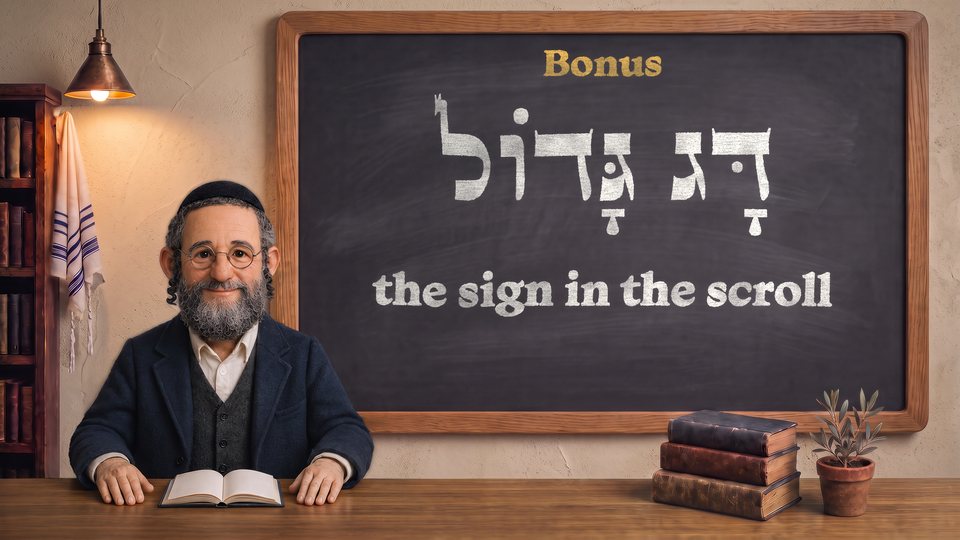
The sign in the scroll
Look up in the Hebrew six things that people know about the book of Jonah, and see what the old translations did with each of them
TranscriptEvery word of the film, with the Hebrew
Download PDFTap a time to play the film from there.
The hook
Everybody knows the book of Jonah. And nearly everybody knows it wrong. Ask what swallowed the prophet; and you will be told: a whale. Ask what grew over his head; and you will hear: a gourd. Or nothing at all.
You can do something better than remember. You can look.
Welcome
שָׁלוֹם Shalom. I am Moreh Ezra; and this is a bonus. Shorter than a lesson. No new rules. And if you have come here without the lessons before it; you can still follow every step.
We take six things that people know about Jonah; and look each of them up in the Hebrew. And then we look over the shoulders of three old translators. The Greek Bible; made by Jews in Egypt, some two hundred years before the common era. The Latin Bible of Jerome; about the year four hundred. And the English Bible of sixteen eleven.
One: a fish, and no whale
One. The fish. The Hebrew has two words. דָּג גָּדוֹל Dag gadol. דָּג Dag: a fish.
The ordinary word; any fish. גָּדוֹל Gadol: great. Big. The storyteller names no kind.
The Greek Bible has: ketos. A great creature of the sea. Jerome has: piscem grandem. A great fish. And the King James, in Jonah: a great fish.
So where does the whale come from? Not from the book of Jonah. It comes from one verse of the New Testament. In the Gospel of Matthew, written in Greek, Jesus speaks of Jonah, in the belly of the ketos; the word of the Greek Bible. English Bibles wrote, whale, there; from Wycliffe on.
And in sixteen eleven, the King James kept both. A great fish, in Jonah. The whale’s belly, in Matthew. Painters, and children’s Bibles, did the rest.
The Hebrew says: a great fish. The whale swam in, through the Greek.
Two: a dove, son of Faithful
Two. The name. יוֹנָה Yonah. It is a common noun; and it means: a dove. The bird that Noah sent out over the water.
וַיְשַׁלַּח אֶת הַיּוֹנָה Va-yeshallach et ha-yonah. And he sent out the dove.
His father’s name, Amittai; comes from אֱמֶת emet. Truth. Faithfulness. If you have the fourth bonus; you know that word. So the man is: Dove; son of Faithful.
A strange name, for the man in this story. The storyteller surely knew it.
But he did not make it up. The book of Kings knows him too. יוֹנָה בֶן אֲמִתַּי הַנָּבִיא אֲשֶׁר מִגַּת הַחֵפֶר Yonah ven Amittai ha-navi asher mi-Gat ha-Chefer. Jonah, son of Amittai; the prophet; who was from Gath-hepher. A village in Galilee.
He lived in the days of King Jeroboam the second; in the eighth century before the common era; when Assyria was the great power in the east; and Nineveh, one of its great cities.
And notice the word, prophet. It stands in Kings. In the book of Jonah itself; it does not stand once.
One more dove. The prophet Hosea lived in the same century; and he says of his own people: כְּיוֹנָה פוֹתָה אֵין לֵב ke-yonah fotah ein lev. Like a silly dove, without sense. To Egypt they call; to Assyria they go. A dove; and Assyria; in one line.
Three: the far end of the sea
Three. Tarshish. Jonah was sent east; to Nineveh. He went down to the harbour; and took a ship west. For Tarshish.
Nobody knows for certain where Tarshish was. Many look for it at the far end of the Mediterranean; in the south of Spain. For the Bible, it is simply the longest voyage there is. King Solomon had ships of Tarshish. אַחַת לְשָׁלֹשׁ שָׁנִים תָּבוֹא אֳנִי תַרְשִׁישׁ Achat le-shalosh shanim tavo oni Tarshish.
Once in three years, the ships of Tarshish came home. With gold; and silver; ivory; apes; and, says the King James, peacocks.
So to say: he took a ship for Tarshish; was to say: he went as far away, as a man can go. And here, the translators left the name alone.
Four: the plant with no name
Four. The plant. In the last chapter, a plant grows up over Jonah’s head, in a night; and gives him shade. The Hebrew word is: קִיקָיוֹן qiqayon. It stands five times in that chapter; and nowhere else in the Bible.
Nobody is sure what plant it was.
The Greek Bible wrote: a gourd. The old Latin Bible followed: a gourd. Then Jerome made his new translation, from the Hebrew; and decided that, gourd, was wrong. Had he written the Hebrew word, he said, nobody would have known what it meant. Other translators had written, ivy.
So he wrote: ivy.
Augustine wrote to him, about what happened next. A bishop in North Africa used the new translation in church. And when the people heard, ivy; where they had always heard, gourd; there was such an uproar, that the bishop had to go back to the old word; or lose his congregation.
The King James went back too. A gourd. Many scholars today, think of the castor-oil plant. And many modern Bibles say only: a plant. That is honest.
A translator who meets a word that stands in one chapter of one book; has very little to go on.
Five: forty days, or three
Five. The sermon. Jonah’s whole sermon is five Hebrew words long. Here are the first three. עוֹד אַרְבָּעִים יוֹם Od arba’im yom.
Yet forty days. אַרְבָּעִים Arba’im: forty. It is the number four; with the plural ending. Forty days: as long as the rain fell, in the days of Noah. As long as Moses was on the mountain.
Now open the Greek Bible, at the same verse. It says: yet three days. Nobody knows how the three got there. Perhaps a copyist had the three days of the fish in his ear. The Latin, and the English, follow the Hebrew; and say forty.
It is a small thing. But it shows why this course sends you to the Hebrew. Every translation is somebody’s reading of the text. And now and then; somebody’s slip.
Six: the scroll, and the sign
Six. The sign. In a Hebrew Bible, Jonah does not stand alone. It is the fifth of twelve short books of prophets; written together on one scroll, and counted as one book. The Twelve.
Hosea, with his silly dove, is the first of them.
And the book has a fixed day in the Jewish year. The whole of it is heard in the synagogue; on the afternoon of the Day of Atonement. The day of fasting; and of turning back.
And the sign? The Hebrew word for a sign, is אוֹת ot. In the book of Jonah; it does not stand at all. It comes from the Gospels; where Jesus says that no sign will be given; but the sign of the prophet Jonah. The Gospels point to two things in the book.
The three days and three nights. And the people of Nineveh; who listened.
So the story of a prophet who ran away; became a book that is heard on the most solemn day of one faith; and quoted at the heart of another. That is a great deal of weight, for forty-eight verses to carry. They carry it.
What you just did
You took six things that everybody knows; and you looked. The fish has no kind. The man has a name that means, dove; a father; a village; and a king. Tarshish is the longest voyage there is. The plant has a name; and no translation.
The forty days are three, in Greek. And the sign, is not in the book.
One thing to do. Read Jonah three and four, in your own Bible. See what it calls the plant; and whether a footnote admits, that nobody knows.
And when somebody tells you what the Bible says; ask one question. In which language? שָׁלוֹם Shalom.
Until next time: לֵךְ לְשָׁלוֹם lekh leshalom. Go in peace.
וַיְמַ֤ן יְהוָה֙ דָּ֣ג גָּד֔וֹל לִבְלֹ֖עַ אֶת־יוֹנָ֑ה
wayman [the LORD] dāg gādôl, livlōa' 'et-yônâ
"And the LORD appointed a great fish to swallow Jonah." (Jonah 1:17; 2:1 in Hebrew Bibles)
Everybody knows the book of Jonah, and nearly everybody knows it wrong. Ask what swallowed the prophet, and you will be told: a whale. Ask what grew over his head, and you will hear "a gourd", or nothing at all.
You can now do something better than remember. You can look. This page takes six things that people know about Jonah and looks each of them up in the Hebrew. Then it looks at what the old translators made of it: the Greek Bible of the Jews of Egypt, some two hundred years before the common era, the Latin Bible of Jerome, about the year 400, and the English Bible of 1611.
This is a bonus: shorter than a lesson, free, and with no new rules. A note on the letters, if you have come to this page first: ô, â and î are long vowels, š is said "sh", and ḥ is the ch of "loch". In the lines of Hebrew sounds the name of God is not written out. You will see [the LORD] there.
1. A fish, and no whale
The Hebrew has two words: דָּג גָּדוֹל dāg gādôl, "a great fish". dāg is the ordinary word for a fish, any fish. gādôl is "great, big". The storyteller names no kind.
| The Bible | What it says | In English |
|---|---|---|
| Hebrew | דָּג גָּדוֹל dāg gādôl | "a great fish" |
| Greek | kētos mega | "a great sea creature" |
| Latin | piscem grandem | "a great fish" |
| English, 1611 | "a great fish" |
So where does the whale come from? Not from the book of Jonah. It comes from one verse of the New Testament. In the Gospel of Matthew, written in Greek, Jesus speaks of Jonah "in the belly of the kētos", using the word of the Greek Bible. A kētos was any huge creature of the sea. English Bibles had written "whale" there since Wycliffe. The translators of 1611 kept it, "the whale's belly" in Matthew 12:40, and wrote "a great fish" in Jonah.
The Hebrew says "a great fish". The whale swam in through the Greek.
2. A dove, son of Faithful
The prophet's name is a common noun. יוֹנָה yônâ is a dove. It is the bird that Noah sent out over the water:
וַיְשַׁלַּ֥ח אֶת־הַיּוֹנָ֖ה
wayšallaḥ 'et-hayyônâ
"And he sent out the dove." (Gen 8:8)
His father's name, 'ămittay, comes from 'ĕmet, the "truth" or "faithfulness" that you met in the fourth bonus beside ḥésed. "Dove, son of Faithful" is a strange name for the man in this story, and the storyteller surely knew it.
But he did not make the name up. The book of Kings knows this prophet too:
אֲשֶׁ֣ר דִּבֶּ֗ר בְּיַד־עַבְדּ֞וֹ יוֹנָ֤ה בֶן־אֲמִתַּי֙ הַנָּבִ֔יא אֲשֶׁ֖ר מִגַּ֥ת הַחֵֽפֶר׃
'ăšer dibber bəyad-'avdô yônâ ven-'ămittay hannāvî', 'ăšer miggat haḥēfer
"... which he spoke by the hand of his servant Jonah son of Amittai, the prophet, who was from Gath-hepher." (2 Kgs 14:25)
That is all we are told. Jonah came from a village in Galilee. He lived in the days of King Jeroboam the second, in the eighth century before the common era, when Assyria was the great power to the east and Nineveh one of its great cities. And the only other message of his that the Bible records was good news for his own country: its borders would be restored.
Notice the word "prophet" in that verse. In the book of Jonah itself it does not stand once.
One more thing about doves. The prophet Hosea lived in the same century, and he says of his own people:
וַיְהִ֣י אֶפְרַ֔יִם כְּיוֹנָ֥ה פוֹתָ֖ה אֵ֣ין לֵ֑ב מִצְרַ֥יִם קָרָ֖אוּ אַשּׁ֥וּר הָלָֽכוּ׃
wayhî 'efráyim, kəyônâ fôtâ 'ên lēv, miṣráyim qārā'û 'aššûr hālākhû
"And Ephraim has become like a silly dove, without sense: to Egypt they call, to Assyria they go." (Hos 7:11)
A dove, and Assyria, in one line. Readers of the scroll in which both books stand could hardly miss it.
3. The far end of the sea
Jonah was sent east, and he took a ship for taršîš. Nobody knows for certain where Tarshish was. Many look for it in the far west of the Mediterranean, in the south of Spain. For the Bible it is simply the longest voyage there is:
אַחַת֩ לְשָׁלֹ֨שׁ שָׁנִ֜ים תָּב֣וֹא ׀ אֳנִ֣י תַרְשִׁ֗ישׁ
'áḥat ləšālōš šānîm tāvô' 'ŏnî taršîš
"Once in three years the ships of Tarshish would come." (1 Kgs 10:22)
King Solomon's ships of Tarshish came home once in three years, with gold, silver, ivory, apes and peacocks. To say "he took a ship for Tarshish" was to say "he went as far away as a man can go".
The translators left the name alone. Greek has Tharsis, Latin has Tharsis, and the English of 1611 has "Tarshish".
4. The plant with no name
In chapter 4 a plant grows up over Jonah's head in a night and gives him shade. The Hebrew word is קִיקָיוֹן qîqāyôn. It stands five times in that chapter and nowhere else in the Bible. Nobody is sure what plant it was.
| The Bible | The word | In English |
|---|---|---|
| Hebrew | קִיקָיוֹן qîqāyôn | ? |
| Greek | kolokyntha | "a gourd" |
| Latin, before Jerome | cucurbita | "a gourd" |
| Latin, Jerome | hedera | "ivy" |
| English, 1611 | "a gourd" |
When Jerome made his new Latin translation from the Hebrew, he decided that the old "gourd" was wrong. Had he written the Hebrew word, he said, nobody would have known what it meant. Other translators had written "ivy", and so did he. Augustine wrote to him about what happened next. A bishop in North Africa had the new translation read in church. When the people heard "ivy" where they had always heard "gourd", there was such an uproar that the bishop had to go back to the old word or lose his congregation.
Many scholars today think of the castor-oil plant, which grows fast, has broad leaves and wilts quickly. Modern English Bibles often say only "a plant" or "a bush". That is honest. A translator who meets a word that stands in one chapter of one book has very little to go on.
5. Forty days, or three
Jonah's whole sermon is five Hebrew words long, and Lesson 44 will read it. Here is its first half:
ע֚וֹד אַרְבָּעִ֣ים י֔וֹם
'ôd 'arbā'îm yôm
"Yet forty days ..." (Jonah 3:4)
אַרְבָּעִים 'arbā'îm is "forty": the number four with the plural ending. Forty days is how long the rain fell in the days of Noah, and how long Moses was on the mountain.
Now open the Greek Bible at the same verse. It says: "yet three days". Nobody knows how the three got there. Perhaps a copyist had the "three days" of the fish in his ear, or the city that was "three days' walk" across. The Latin and the English follow the Hebrew and say forty.
It is a small thing. But it shows you why this course sends you to the Hebrew.
6. The scroll, and the sign
In a Hebrew Bible, Jonah does not stand alone. It is the fifth of twelve short books of prophets that were written together on one scroll and counted as one book, "the Twelve". Hosea, with his silly dove, is the first of them.
Both of the books that you are reading in this stage have a fixed day in the Jewish year. Ruth, the harvest story, is read at the Feast of Weeks, the festival of the wheat harvest, seven weeks after Passover. Jonah is read aloud, from beginning to end, on the afternoon of the Day of Atonement, the day of fasting and of turning back. When you have read chapter 3 you will see why.
And the word "sign"? You learned אוֹת 'ôt, "sign", in Lesson 35. It does not stand in the book of Jonah at all. It comes from the Gospels, where Jesus says that no sign will be given "but the sign of the prophet Jonah". The Gospels speak of two things in the book: the three days and three nights, and the people of Nineveh, who listened.
So the story of a prophet who ran away became a book that is read on the most solemn day of one faith and quoted at the heart of another. That is a great deal of weight for forty-eight verses to carry. They carry it.
7. What you just did
You took six things that "everybody knows", and you looked. The fish has no kind. The prophet has a name that means "dove", a father, a village and a king. Tarshish is the far end of the sea. The plant has a name and no translation. The forty days are three in Greek. And the book sits on a scroll with eleven others.
Before next time Read Jonah 3 and 4 in your own Bible. Look at what it calls the plant, and whether a footnote admits that nobody knows.
8. Words
| Transliteration | Meaning | Root | Script |
|---|---|---|---|
| yônâ | dove | יוֹנָה | |
| nāvî' | prophet | נָבִיא | |
| qîqāyôn | a fast-growing plant (which one is not known) | קִיקָיוֹן | |
| 'arbā'îm | forty | אַרְבָּעִים |
Exercises
Type your answers in plain letters; accents and hyphens don't matter. The four new words of this bonus are on the Vocabulary page too.