BonusMEBH-03-05
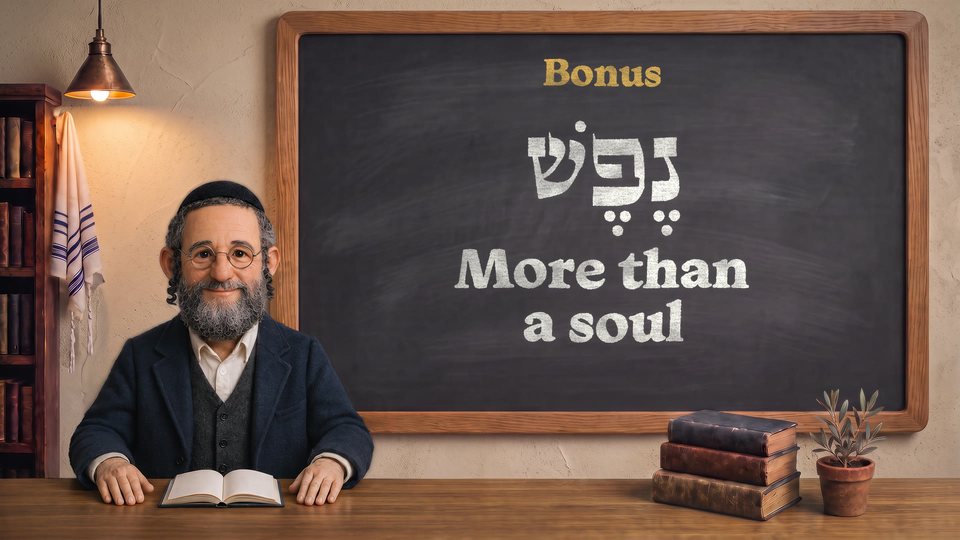
More than a soul
Read Genesis 2:7 in Hebrew yourself, and see why one word becomes soul, life, throat, person and "me" in English
TranscriptEvery word of the film, with the Hebrew
Download PDFTap a time to play the film from there.
A living soul, and a fish
In the King James Bible, God breathes into the man, and the man becomes a living soul. One chapter earlier, the fish in the sea get the very same two Hebrew words. Nobody told you, because the translation changed them. Today I keep a promise; and you will read those two words yourself.
A promise kept
שָׁלוֹם Shalom, and welcome to another bonus. I am Moreh Ezra. In the film of the seventy words, I said that one of them would get a lesson of its own. The word was נֶפֶשׁ nefesh. Usually: soul.
I keep my promises. Today. And in Lesson six I wrote that word on this board, and under it: a soul. Today I take that back. Most of it.
The word stands in the Hebrew Bible seven hundred and fifty-four times. The King James Bible says soul for it about six times in ten. For the rest, it needs dozens of other words: life, person, heart, mind, creature, body, desire. Five times: dead. And once, in Isaiah: fish.
One Hebrew word; and English keeps changing its mind. No new rules today; you have had enough of those. You know the patterns, the little words on the front, and how one noun leans on the next. Today they all go to work on one word. And I warn you: by the end, you will never see the word soul in your Bible in quite the same way again.
In a good way. I promise.
Genesis 2:7, word by word
Genesis two, verse seven. God forms the man from the dust, and breathes into his nostrils נִשְׁמַת חַיִּים nishmat chayyim: the breath of life. Two nouns, the first one leaning on the second: Lesson six. And then: וַיְהִי הָאָדָם לְנֶפֶשׁ חַיָּה vayhi ha-adam le-nefesh chayyah. Take it apart with me.
The first word, וַיְהִי vayhi: and it was. You have known it since Lesson three: and there was light. Then הָאָדָם ha-adam: the man, with the article; you met him in the first bonus. Then one small letter on the front, le-: to. In Hebrew, you do not become something.
You are to it. And the man was to a living נֶפֶשׁ nefesh: the man became a living נֶפֶשׁ nefesh. Now the word itself. It is shaped like מֶלֶךְ melekh, a king: Lesson four. And it is a she, though it has no feminine ending: Lesson six.
How do we know? Look at the word after it: חַיָּה chayyah, living. It has the feminine ending. An adjective agrees with its noun, like the well-brought-up child of Lesson six; so the noun is a she. Now notice the shape of the sentence.
God breathes in; and the man becomes a נֶפֶשׁ nefesh. He does not receive one. He does not get one installed. He is one.
The same words for a fish
Now go back one chapter. Day five: יִשְׁרְצוּ הַמַּיִם שֶׁרֶץ נֶפֶשׁ חַיָּה yishretsu ha-mayim sherets nefesh chayyah. Let the waters swarm with swarms of living נֶפֶשׁ nefesh. Fish. Day six: תּוֹצֵא הָאָרֶץ נֶפֶשׁ חַיָּה totse ha-arets nefesh chayyah.
Let the earth bring out living נֶפֶשׁ nefesh. Cattle, creeping things, wild animals. The same two words as the man. And again in chapter two, for every animal that the man names. Six times in the first two chapters of the Bible; and five of the six are animals.
Here is what the King James Bible does with them. For the fish: the moving creature that hath life. For the cattle: the living creature. For the animals the man names: every living creature. And for the man himself: a living soul.
So an English reader meets a soul only in the man’s verse, and thinks: there it is; that is what makes us different. A Hebrew reader hears the same two words, six times. Does that make the man just another animal? Not in Genesis. The text sets him apart in other ways.
Only of him does it say that God breathed into his nostrils. Only humankind is made in the image of God. And it is the man who gives the animals their names; nobody asks the fish. How much each of these means, people have discussed for a very long time. But the two words are not one of the differences.
Most modern Bibles now say: a living being; which is closer to the other five.
A throat before a soul
Where does the word come from? The older neighbours of Hebrew help. In Akkadian, and in Ugaritic, the same word means the throat. And from the throat: breath, appetite, life. Hebrew still uses it that way.
Psalm sixty-nine: הוֹשִׁיעֵנִי אֱלֹהִים כִּי בָאוּ מַיִם עַד נָפֶשׁ hoshi’eni Elohim, ki va’u mayim ad nafesh. Save me, God; for the waters have come up to the נֶפֶשׁ nefesh. The King James says: unto my soul. Newer Bibles say: up to my neck. Picture the water rising.
The neck is where it gets serious. Look at the first vowel of our word on the board: it has changed. At a pause, Hebrew likes to stretch a vowel. It is the same word. Jonah, inside the fish, says the same: the waters closed around me, up to the נֶפֶשׁ nefesh.
And in Jeremiah, a sword reaches the same place. Water twice, a sword once. You want neither of them up to there. The throat is also where hunger lives. Proverbs twenty-seven: נֶפֶשׁ שְׂבֵעָה תָּבוּס נֹפֶת nefesh sve’ah tavus nofet.
A full נֶפֶשׁ nefesh tramples on honey; but to a hungry נֶפֶשׁ nefesh, every bitter thing is sweet. Any parent of a teenager knows that proverb. Appetite fits better than soul. Isaiah even gives the underworld an appetite: Sheol has opened wide its נֶפֶשׁ nefesh, and opened its mouth. A throat, wide open.
And the ladies of Jerusalem, two chapters earlier, carry houses of the נֶפֶשׁ nefesh. The King James Bible says: tablets. Newer Bibles say: perfume boxes. A little house for a breath. That is a guess; but it is a good one.
And there is a verb from the same root. It stands only three times in the whole Bible, and it means: to catch your breath. A servant’s son does it, on the seventh day. King David does it, worn out, on the run from his own son. And the third is God himself, after the six days of creation: he rested, וַיִּנָּפַשׁ va-yinnafash.
And he caught his breath. Most translations say, very politely: and was refreshed. The Hebrew is bolder. I like it.
Life, persons, and “me”
From throat and breath, it is one short step to life itself. Leviticus seventeen: כִּי נֶפֶשׁ הַבָּשָׂר בַּדָּם ki nefesh ha-basar ba-dam. For the נֶפֶשׁ nefesh of the flesh is in the blood. One noun leaning on the next: Lesson six. And the last word, in the blood, hides its article in a vowel: Lesson five.
Here even the King James Bible says: life. A נֶפֶשׁ nefesh can also be counted. Genesis forty-six: כָּל הַנֶּפֶשׁ לְבֵית יַעֲקֹב הַבָּאָה מִצְרַיְמָה שִׁבְעִים kol ha-nefesh le-vet Ya’aqov ha-ba’ah Mitsraymah, shiv’im. All the נֶפֶשׁ nefesh of the house of Jacob, that came to Egypt: seventy. Seventy persons; and the word stays in the singular, like a head count.
In the film of the seventy words I told you: seventy went down into Egypt. Here they are. And now, the commonest form of this word in the whole Bible. It is not the bare word. It has a small ending, -i, for my: נַפְשִׁי nafshi.
My נֶפֶשׁ nefesh. A hundred and ninety-two times somebody says it; more than half of them in the Psalms. And very often it simply means: me. Psalm one hundred and three: בָּרֲכִי נַפְשִׁי barakhi nafshi. Bless the LORD, my נֶפֶשׁ nefesh.
Look at the verb. It is a command; and by its ending, a command to a woman. The psalmist talks to his נֶפֶשׁ nefesh as she, because the word is a she. He is talking to himself; all of himself. I do that every morning; usually about coffee.
Come on, me, says the psalmist. Bless the LORD. One last surprise. In the book of Numbers, a Nazirite must not go near a נֶפֶשׁ מֵת nefesh met: word for word, a dead נֶפֶשׁ nefesh. Translations rightly say: a dead body.
In English, a dead soul sounds very strange. In Hebrew, it shows how bodily this word is. Does that mean the Hebrew Bible knows nothing after death? That is a different question, and a much bigger one; Jewish and Christian traditions, and scholars, answer it in different ways. One word cannot settle it.
What the word does show is this. A נֶפֶשׁ nefesh is not a small part hidden inside a person. It is the whole living, breathing, hungry person.
What you just did
Look at what you just did. You read Genesis two, verse seven, word by word. You found the same two words for a fish, and for the man. And you followed one word from the throat, to the appetite, to the life, to the person; and to me. The translators are still on that road.
The King James Bible wrote soul for this word four hundred and seventy-five times. A word-for-word English made in Cambridge, in our own day, writes it twenty-seven times. So when you meet the word soul in your English Bible now, you will stop for half a second, and ask: which נֶפֶשׁ nefesh is this? The throat? The life?
The whole person? That half second is reading Hebrew.
One thing to do
One thing to do before next time. This one needs Biblion: Biblion app dot com. Go to Psalm sixty-nine. In Options, switch to the Study Bible, and tap the small number after the word soul, in verse one. Biblion shows you נֶפֶשׁ nefesh; and under it, a way to see every verse where it stands.
Pick five of them. For each one, decide: throat, appetite, life, person, or me. Then look at what your own Bible says. You will be surprised how often you agree with the translators; and how often you do not. Next time, we are back to work.
But keep this word close. You will meet it seven hundred and fifty-four times.
Until next time: לֵךְ לְשָׁלוֹם lekh leshalom. Go in peace.
וַיְהִי הָאָדָם לְנֶפֶשׁ חַיָּה
wayhî hā'ādām lənéfeš ḥayyâ: "and man became a living soul" (Gen 2:7, King James Version)
One chapter earlier, the fish in the sea get the very same two Hebrew words. Nobody told you, because the translation changed them.
In the film of the seventy words, Moreh Ezra said of נֶפֶשׁ néfeš: "Keep it in mind; it will get a lesson of its own." This is that lesson: a promise kept. And in Lesson 6 he wrote the word on the board, and under it "a soul". Today he takes that back. Most of it.
This is a bonus: shorter than a lesson, free, and with no new rules; you have had enough of those. You know the patterns, the little words on the front, and how one noun leans on the next. Today they all go to work on one word.
néfeš stands 754 times in the Hebrew Bible. The King James Version says "soul" for it about six times in ten. For the rest it needs dozens of other words: life, person, heart, mind, creature, body, desire. Five times it says "dead". And once, in Isaiah 19:10, "fish": the Hebrew there is אַגְמֵי־נָפֶשׁ 'agmê-nāfeš, where the King James translators saw ponds of living things, and newer Bibles read "grieved in néfeš", sick at heart.
A warning from Moreh Ezra: by the end you will never see the word "soul" in your Bible in quite the same way again. In a good way.
1. Genesis 2:7, word by word
וַיְהִי הָאָדָם לְנֶפֶשׁ חַיָּה
wayhî hā'ādām lənéfeš ḥayyâ
"and the man became a living néfeš"
Every piece is already yours:
- וַיְהִי wayhî "and (it) was": the narrative chain form of "to be" (Lessons 3 and 9).
- הָאָדָם hā'ādām "the man", with the article (Lesson 5, and the first bonus).
-
לְ lə- "to, for" (Lesson 5). With "to be", Hebrew says "he was to something" where English says "he became something".
-
נֶפֶשׁ néfeš: shaped like מֶלֶךְ mélekh "a king", the pattern CéCeC (Lesson 4). And it is a "she", though it has no feminine ending (Lesson 6).
-
חַיָּה ḥayyâ "living", with the feminine -â. This is how we know that néfeš is a she: an adjective agrees with its noun. Its root is the root of חַיִּים ḥayyîm "life".
Just before this, the verse says God breathed into the man's nostrils נִשְׁמַת חַיִּים nišmat ḥayyîm, "the breath of life": two nouns, the first leaning on the second, the construct chain of Lesson 6. Now notice the shape of the sentence. God breathes in, and the man becomes a living néfeš. He does not receive one. He does not get one installed. He is one.
2. The same words for a fish
Now go back one chapter.
יִשְׁרְצוּ הַמַּיִם שֶׁרֶץ נֶפֶשׁ חַיָּה
yišrəṣû hammáyim šéreṣ néfeš ḥayyâ
"Let the waters swarm with swarms of living néfeš." (Gen 1:20, day five)
Fish, and everything else that swarms in the water.
תּוֹצֵא הָאָרֶץ נֶפֶשׁ חַיָּה
tôṣē' hā'āreṣ néfeš ḥayyâ
"Let the earth bring out living néfeš." (Gen 1:24, day six)
Cattle, creeping things, wild animals: the very same two words as the man in 2:7. And again in chapter 2, for every animal that the man names. Six times in the first two chapters of the Bible, and five of the six are animals. Here is what the King James Version does with them:
| Verse | Who | Hebrew | Read it | King James Version |
|---|---|---|---|---|
| Gen 1:20 | what swarms in the water | נֶפֶשׁ חַיָּה | néfeš ḥayyâ | "the moving creature that hath life" |
| Gen 1:21 | every creature of the water | נֶפֶשׁ הַחַיָּה | néfeš haḥayyâ | "every living creature" |
| Gen 1:24 | cattle and wild animals | נֶפֶשׁ חַיָּה | néfeš ḥayyâ | "the living creature" |
| Gen 1:30 | every animal, bird and creeping thing | נֶפֶשׁ חַיָּה | néfeš ḥayyâ | "(wherein there is) life" |
| Gen 2:7 | the man | לְנֶפֶשׁ חַיָּה | lənéfeš ḥayyâ | "a living soul" |
| Gen 2:19 | the animals the man names | נֶפֶשׁ חַיָּה | néfeš ḥayyâ | "every living creature" |
So an English reader meets a "soul" only in the man's verse, and thinks: there it is, that is what makes us different. A Hebrew reader hears the same two words, six times. Most modern Bibles now say "a living being" in 2:7, which is closer to the other five.
Does that make the man just another animal? Not in Genesis. The text sets him apart in other ways. Only of him does it say that God breathed into his nostrils (2:7). Only humankind is made in the image of God (1:27). And it is the man who gives the animals their names (2:19); nobody asks the fish. How much each of these means, people have discussed for a very long time. But the two words néfeš ḥayyâ are not one of the differences.
3. A throat before a soul
Where does the word come from? The older neighbours of Hebrew help. In Akkadian (napištu) and in Ugaritic (npš) the same word is also the throat; and from the throat come breath, appetite and life. That is how the dictionaries tell the word's story, and Hebrew still uses it that way:
הוֹשִׁיעֵנִי אֱלֹהִים כִּי בָאוּ מַיִם עַד־נָפֶשׁ
hôšî'ēnî 'ĕlōhîm kî vā'û máyim 'ad-nāfeš
"Save me, God, for the waters have come up to the néfeš." (Ps 69:1; 69:2 in Hebrew Bibles)
The King James Version says "unto my soul"; newer Bibles say "up to my neck". Picture the water rising: the neck is where it gets serious. Look at the first vowel of our word: it has changed. At a pause, Hebrew likes to stretch a vowel, so néfeš becomes nāfeš. It is the same word. (And vā'û has a soft v because a vowel comes right before it, Lesson 3.)
Jonah, inside the fish, says the same: אֲפָפוּנִי מַיִם עַד־נֶפֶשׁ 'ăfāfûnî máyim 'ad-néfeš, "the
waters closed around me, up to the néfeš" (Jonah 2:5; 2:6 in Hebrew Bibles). And in
Jeremiah a sword reaches the same place: וְנָגְעָה חֶרֶב עַד־הַנָּפֶשׁ wənāgə'â ḥérev
'ad-hannāfeš (Jer 4:10). Water twice, a sword once. You want neither of them up to there. 
The throat is also where hunger lives:
נֶפֶשׁ שְׂבֵעָה תָּבוּס נֹפֶת וְנֶפֶשׁ רְעֵבָה כָּל־מַר מָתוֹק
néfeš śəvē'â tāvûs nōfet wənéfeš rə'ēvâ kol-mar mātôq
"A full néfeš tramples on honey, but to a hungry néfeš every bitter thing is sweet." (Prov 27:7)
Any parent of a teenager knows that proverb: "appetite" fits better than "soul". Isaiah even gives the underworld an appetite: לָכֵן הִרְחִיבָה שְּׁאוֹל נַפְשָׁהּ lākhēn hirḥîvâ šə'ôl nafšāh, "therefore Sheol has opened wide its néfeš", and the verse goes on, "and opened its mouth" (Isa 5:14). A throat, wide open.
And the ladies of Jerusalem, two chapters earlier, carry וּבָתֵּי הַנֶּפֶשׁ ûvāttê hannéfeš, "houses of the néfeš" (Isa 3:20). The King James Version says "tablets"; newer Bibles say "perfume boxes". A little house for a breath. That is a guess, but it is a good one.
There is also a verb from the same root. It stands only three times in the whole Bible, and it means to catch your breath. A servant's son does it, on the seventh day (Exod 23:12). King David does it, worn out, on the run from his own son (2 Sam 16:14). And the third is God himself, after the six days of creation:
וּבַיּוֹם הַשְּׁבִיעִי שָׁבַת וַיִּנָּפַשׁ
ûvayyôm haššəvî'î šāvat wayyinnāfaš
"and on the seventh day he rested and caught his breath." (Exod 31:17)
Most translations say, very politely, "and was refreshed". The Hebrew is bolder. Moreh Ezra likes it.
4. Life, persons, and "me"
From throat and breath it is one short step to life itself:
כִּי נֶפֶשׁ הַבָּשָׂר בַּדָּם…
kî néfeš habbāśār baddām...
"For the néfeš of the flesh is in the blood..." (Lev 17:11)
One noun leaning on the next, "the néfeš of the flesh" (Lesson 6); and baddām "in the blood" hides its article in a vowel (Lesson 5). Here even the King James Version says "life".
A néfeš can also be counted:
כָּל־הַנֶּפֶשׁ לְבֵית־יַעֲקֹב הַבָּאָה מִצְרַיְמָה שִׁבְעִים
kol-hannéfeš ləvêt-ya'ăqōv habbā'â miṣráymâ šiv'îm
"All the néfeš of the house of Jacob who came to Egypt: seventy." (Gen 46:27)
Seventy persons; and the word stays in the singular, like a head count. In the film of the seventy words Moreh Ezra said: "seventy went down into Egypt". Here they are.
And now the commonest form of this word in the whole Bible. It is not the bare word. It has a small ending, -î "my": נַפְשִׁי nafšî, "my néfeš". Written just so it stands 172 times, more than any other form of the word (the bare נֶפֶשׁ: 108). Count every "my néfeš", also with a little word on the front, and somebody says it 192 times; 104 of them are in the Psalms. And very often it simply means "me":
בָּרֲכִי נַפְשִׁי אֶת־יְהוָה
bārăkhî nafšî 'et-[the LORD]
"Bless the LORD, my néfeš." (Ps 103:1)
Look at the verb: bārăkhî ends in -î too, the ending of a command to a woman. The
psalmist talks to his néfeš as "she", because the word is a she (Lesson 6). He is
talking to himself, all of himself. (Moreh Ezra does that every morning; usually about
coffee.) "Come on, me," says the psalmist. "Bless the LORD."
One last surprise. In Numbers 6:6 a Nazirite must not go near עַל־נֶפֶשׁ מֵת 'al-néfeš mēt, word for word "a dead néfeš". Translations rightly say "a dead body". In English a dead soul sounds very strange. In Hebrew it shows how bodily this word is.
Does that mean the Hebrew Bible knows nothing after death? That is a different question, and a much bigger one; Jewish and Christian traditions, and scholars, answer it in different ways.
What the word does show is this: a néfeš is not a small part hidden inside a person. It is the whole living, breathing, hungry person.
What you just did
Look at what you just did. You read Genesis 2:7 word by word. You found the same two words for a fish and for the man. And you followed one word from the throat, to the appetite, to the life, to the person; and to me.
The translators are still on that road. The King James Version wrote "soul" for this word 475 times. A word-for-word English made in Cambridge in our own day writes it 27 times. (That one is STEPBible's word-by-word English, from Tyndale House: every Hebrew word with its English in its place. A study tool, not a Bible for the pulpit; but it shows where the road is going.)
So when you meet the word "soul" in your English Bible now, you will stop for half a second and ask: which néfeš is this? The throat? The life? The whole person? That half second is reading Hebrew.
Before next time This one needs Biblion: biblionapp.com. Go to Psalm 69. In Options, switch to the Study Bible. Under verse 1 stands the King James line, "for the waters are come in unto my soul", with a small number after each word; tap the one after "soul". Biblion shows you נֶפֶשׁ, and under it a way to see every verse where it stands. Pick five of them. For each one, decide: throat, appetite, life, person, or me. Then look at what your own Bible says. You will be surprised how often you agree with the translators; and how often you do not.
Next time, we are back to work. But keep this word close. You will meet it 754 times.